


 Zamówienia telefoniczne:
 .png)


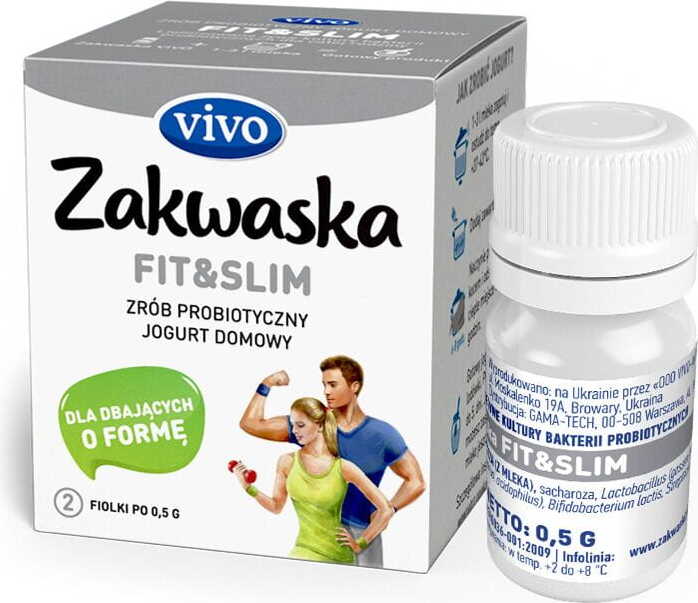
Homemade yogurt FIT & SLIM live bacterial cultures, probiotic, packaging 2 x 0,5g ZAKWASKI VIVO

 Description
Ingredients
Streptococcus thermophilus, Lactobacillus delbrueckii ssp. Bulgaricus, Lactobacillus acidophilus, Bi dobacterium lactis, Lactobacillus gasseri
There are approx. 20 billion bacteria in 1 g (including approx. 2 billion L. gaseri). 1 vial contains 0.5 g.
Description
Zakwaska Fit & Slim is a proposal for people who want to change their diet, enter the path of physical activity and a healthy diet. The starter for the preparation of homemade yogurt contains live microflora, and its distinctive ingredient is the Lactobacillus gasseri strain, which has gained recognition as a so-called "fitness probiotic". The yogurt obtained with the Fit & Slim starter is an excellent proposition for people who care and want to take care of a correct figure. Thanks to the right proportions of live bacteria cultures, the obtained yoghurt is an excellent meal free from any added sugars (it contains only naturally occurring sugars) and other unnecessary additives, e.g. powdered milk. Yogurt contains naturally occurring and well absorbed nutrients. It is worth remembering that the exact nutritional value of home-made yogurt depends on the milk you use to make it. We recommend milk with a fat content of 3.2 percent.
How to prepare Vivo homemade yogurt?
The bottle containing powdered Sourdough should be half filled with milk at room temperature, tightly screw the cap on and shake the bottle until the powder is completely dissolved in the bottle. If a little powder sticks to the bottom, you should, for example, use the reverse tip of a teaspoon to rub it thoroughly so that it dissolves in the milk and obtains the finest consistency possible.
After preparing Zakwaska, prepare 1 or 2 liters of pasteurized milk.
In the case of milk straight from the cow, it should be boiled and cooled to a temperature of 37-40 degrees C.
Pasteurized milk does not require cooking. To get the right temperature, boil 1 liter of milk, cool the second in the fridge. Then mix warm and cold milk, then a temperature of around 37-40 ° is obtained, ideal for the growth of bacterial cultures. The milk can also be heated to 37-40 ° by checking the temperature with a kitchen thermometer.
Then pour the contents of the bottle into the previously prepared milk and mix thoroughly.
The whole thing can be left in the pot in which the milk was previously heated (the pot will give the heat needed for bacteria to multiply). The pot should be carefully covered and insulated (e.g. with a towel or blanket), then put away in a warm place. Bacterial milk can also be poured into a thermos flask, jar with lid or bowl with lid. To prevent heat loss, wrap the dish with a large towel or blanket.
The dish should be left for 8-10 hours in a warm place, free from drafts and calm (do not stir). Acidified milk has a thick consistency. If a thermos was used, after acidification, pour its contents into a storage vessel, e.g. a jar, bowl, etc.
We store the finished product in the refrigerator for no longer than 7 days.
All flavorings, fruit, etc. should be added to the yoghurt just before consumption.
You can also prepare yoghurt in a yogurt maker or thermomix - according to the instructions for these devices.
Warning!
All utensils that will come into contact with the milk must be clean. It is recommended to first brew them with boiling water.
Technical data
| BIO Certificate | Not applicable | |
| Producer Country | Poland | |
| Country of origin | France | |
| Gluten-free | Yes | |
| Vegetarian | Yes | |
| Vegan | Yes | |
| Min. expiry date (in days) | 30 |
Related products
Product reviews (0)


 Formy dostawy

DHL
Czas doręczenia:
Darmowa dostawa od xx zł
Wybrane dla Ciebie


Tylko zalogowani użytkownicy mogą dodawać opinię o produkcie